
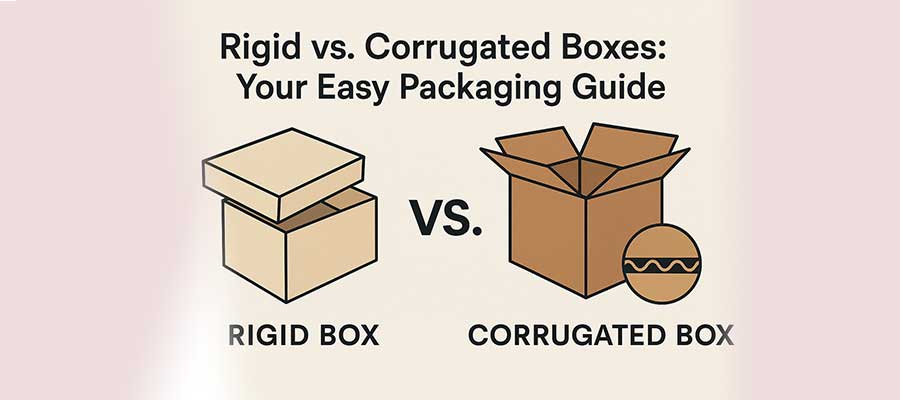
Quick Answer: Rigid vs. Corrugated Boxes
Rigid boxes are premium, non-collapsible packaging made from thick, high-density paperboard. Designed for luxury products, gifting, and brand presentation.
Corrugated boxes? Multi-layered cardboard with a wavy fluted layer sandwiched between flat liners. Lightweight. Cost-effective. Perfect for shipping and e-commerce.
Simple Rule:
- Need branding & luxury appeal → Rigid Box
- Need shipping protection & cost efficiency → Corrugated Box
Table of Contents
Summary: Rigid vs. Corrugated Boxes At-a-Glance
Here’s everything in one place. Quick reference table so you don’t have to scroll through 5,000 words every time you need to make a packaging decision.
| Feature | Rigid Boxes | Corrugated Boxes |
|---|---|---|
| Material Composition | Solid chipboard (600-3000 gsm), 1.5-3mm thick, wrapped in printed paper or fabric | Multi-layer fiberboard with fluted core (125-350 gsm per liner), 3-8mm total thickness |
| Structure & Assembly | Non-collapsible, permanently pre-assembled, fixed shape with reinforced corners | Foldable, flat-pack storage, quick assembly (15-45 seconds), collapsible design |
| Primary Purpose | Brand presentation, luxury appeal, retail display, gifting, creating unboxing experiences | Shipping protection, logistics efficiency, e-commerce fulfillment, cost-effective transit |
| Strength Type | Excellent compression strength, shape retention, crush resistance, edge protection | Superior impact absorption, shock resistance, bursting strength, stacking capability |
| Weight (Empty) | Heavy: 200-500g typical (varies significantly by size and construction) | Light: 50-200g typical (optimizes dimensional weight shipping costs) |
| Cost Range | Premium: $2-$20+ per unit depending on size, features, customization level | Economical: $0.30-$3 per unit based on size, board grade, printing complexity |
| Print Quality | Excellent: offset printing, PMS matching, foil stamping, embossing, UV coating | Good to excellent: flexo, litho-lamination, digital (quality varies by method) |
| Storage Efficiency | Space-intensive: cannot store flat, requires 3-10x more warehouse space | Space-efficient: stores flat achieving 90% space savings, bulk shipment optimized |
| Best Applications | Luxury goods, jewelry, premium electronics, gourmet foods, gifts, high-end retail | E-commerce shipping, subscription boxes, industrial packaging, food delivery, moving |
| Sustainability | Reusable (10+ years typical), mixed materials may complicate recycling, FSC options | Highly recyclable (70-100% post-consumer content), 67-84% recovery rates, biodegradable |
| Typical MOQ | 500-3,000 units for custom designs; 100+ for digital printing options | 100-500 units custom; stock sizes available in smaller quantities immediately |
| Assembly Time | Pre-assembled by manufacturer, no setup required at fulfillment (convenience advantage) | Quick folding assembly required (15-45 seconds per box in fulfillment workflow) |
| Customer Perception | Premium, gift-worthy, luxurious, keeper packaging customers value and retain | Functional, protective, professional, typically disposed after single use |
| Damage Prevention | Excellent for preventing scratches, dents, maintaining pristine product appearance | Excellent for preventing impact damage, drops, vibration, shipping abuse |
| Customization | Extensive: magnetic closures, windows, embossing, ribbons, foam inserts, fabric wraps | Moderate: die-cuts, perforations, handles, windows, various flute types, printing |
| Return Rate Impact | Minimal damage returns due to rigid protection and premium presentation | Low damage returns with proper specification; padding required for fragile items |
1. What Are Rigid Boxes?
Rigid boxes are the premium packaging you see when you unbox an iPhone or open a Tiffany’s ring box. They’re made from thick chipboard—usually 1.5 to 3 mm. Non-collapsible. Pre-assembled. Heavy.
They don’t fold flat like regular cardboard boxes. You can’t squeeze them. That’s the whole point.
1.1 Key Features of Rigid Boxes
Non-Collapsible Structure: These boxes come assembled. They stay assembled. Forever.
Premium Thickness: We’re talking 1.5mm to 3mm thick chipboard. That’s 600-3000 gsm if you want to get technical about it.
Luxurious Finish: Foil stamping. Embossing. Debossing. Spot UV. Soft-touch lamination. All the fancy stuff that makes people go “ooh” when they touch it.
Enhanced Perceived Value: There’s a reason luxury brands use these. When someone opens your product, they should feel like they’re opening a gift, not a delivery.
Durable Construction: Customers keep these boxes. For years. I’ve seen people using iPhone boxes to store jewelry, cables, or random stuff 5 years after buying the phone.
1.2 Common Uses for Rigid Boxes
You’ll find rigid boxes in places where packaging matters as much as the product inside:
Luxury Goods: High-end perfumes, premium cosmetics, luxury skincare lines. Walk into Sephora’s prestige section—rigid boxes everywhere.
Electronics: Flagship smartphones, premium tablets, luxury smartwatches, designer headphones. Apple didn’t spend millions on packaging R&D for nothing.
Jewelry & Accessories: Engagement rings, fine necklaces, luxury watches. Try selling a $5,000 ring in a cardboard box. Good luck.
Gourmet Food & Beverages: Artisan chocolates, premium wine collections, specialty coffee sets. Godiva knows what’s up.
Fashion: Designer shoes, limited edition apparel, luxury handbags. Ever bought Louboutins? The box is half the experience.
Corporate Gifts: Executive gift sets, promotional items for VIP clients. When you’re trying to impress a CEO, a flimsy box won’t cut it.
2. What Are Corrugated Boxes?
Corrugated boxes are the workhorses of the packaging world. Every Amazon delivery you’ve ever gotten? Corrugated. Moving boxes? Corrugated. Pizza boxes? Also corrugated (just thinner).
They’re made from corrugated fiberboard—a fancy way of saying there’s a wavy layer sandwiched between two flat sheets of paper.
The material has three parts:
Outer Liner: The flat paperboard on the outside. Where you print your logo.
Inner Liner: Another flat layer on the inside. Adds strength.
Fluted Medium: The wavy corrugated paper in the middle. This is what gives the box its cushioning and strength.
According to the Fibre Box Association, corrugated packaging is used in approximately 95% of all products shipped in North America, making it the most widely used packaging material in the logistics industry.
2.1 Key Features of Corrugated Boxes
Lightweight Yet Strong: Best strength-to-weight ratio in the packaging game. A box that weighs 100g can protect a 20-pound product.
Shock Absorption: Those flutes aren’t just for show. They compress on impact, protecting whatever’s inside.
Collapsible Design: Ships flat. Stores flat. Assembles in 20 seconds. Warehouse managers love this.
Multiple Grades: Single-wall for light stuff. Double-wall for heavier items. Triple-wall when you’re shipping engine blocks.
Cost-Effective: You can get custom printed corrugated boxes for under a dollar. Try doing that with rigid boxes.
Customizable Options: Different flute types (A, B, C, E, F) give you different strength and cushioning levels. It’s like choosing between regular and extra-cushioned running shoes. For detailed specifications on flute types, check out TAPPI’s technical standards.
2.2 Common Uses for Corrugated Boxes
Corrugated boxes are everywhere. Literally.
E-Commerce Packaging: Amazon-style shipping boxes, subscription box mailers, direct-to-consumer shipments. The entire e-commerce industry runs on corrugated.
Retail Shipping: Master cartons, secondary packaging, display-ready packaging. When products ship from warehouse to store, they’re in corrugated.
Food & Beverage: Pizza delivery boxes, produce containers, beverage carriers. Next time you order pizza, check out that box. Engineering marvel, honestly.
Industrial Applications: Parts packaging, machinery components, automotive supplies. Not sexy, but essential.
Moving & Storage: Household goods boxes, office relocation containers. U-Haul sells millions of these every year.
International Shipping: Export cartons, freight containers, palletized load protection. When stuff crosses oceans, it’s usually in corrugated.
3. Rigid vs. Corrugated Boxes: Key Differences
Let’s get into the real differences. Not just “one’s fancy and one’s not.”
3.1 Material & Construction
Rigid Boxes:
Made from solid chipboard. Compressed recycled paper fibers, 600 to 3000 gsm density. Wrapped in printed paper, specialty fabrics, textured materials, or premium finishes. Permanently assembled using industrial-grade adhesives during manufacturing.
Thick, smooth walls. Sharp corners. Clean edges.
Often include reinforced corners, magnetic closures, ribbon systems, or window cutouts. When you hold one, you know it’s premium.
Corrugated Boxes:
Manufactured from corrugated fiberboard with three or five layers (125-350 gsm per liner). Three or more paper layers bonded together with starch-based adhesives. Foldable design ships flat and assembles on-demand.
You can see the fluted texture on cut edges. Available in various board grades—single-wall, double-wall, triple-wall—depending on what you need.
3.2 Strength & Protection
Rigid Boxes:
Compression strength? Excellent. Stack them high, they won’t crush. Edge protection is top-tier—reinforced corners and thick walls prevent denting. Usually include custom foam inserts, velvet lining, or molded pulp cushioning.
Best for preventing scratches and maintaining pristine condition. If you’re shipping a luxury watch or a glass perfume bottle, rigid boxes keep everything looking showroom-perfect.
Corrugated Boxes:
Impact resistance? Superior. The fluted medium absorbs shocks and vibrations. Bursting strength means they withstand puncture forces and rough handling. Stacking strength (ECT ratings) supports serious weight when palletized.
Best for long-distance shipping, drop testing, freight transportation. Your product might get thrown around by three different carriers—corrugated handles it.
For industry-standard testing protocols, ISTA (International Safe Transit Association) provides comprehensive guidelines on package performance testing.
3.3 Weight & Storage
Rigid Boxes:
Heavier per unit. Typically 200-500g when empty. Cannot be stored flat. They take up warehouse space like nobody’s business—3 to 10 times more than flat corrugated. Higher dimensional weight shipping costs when you’re moving empty boxes to fulfillment centers.
Pre-assembly is convenient but expensive.
Corrugated Boxes:
Significantly lighter. Usually 50-200g empty. Ship and store completely flat—90% space savings. Easy to assemble on-demand during packing (15-45 seconds per box). Lower freight costs for bulk shipments.
Flexible inventory management. Just-in-time delivery. Warehouse managers smile when they see corrugated.
3.4 Cost Comparison
Rigid Box Cost:
Unit cost: $2 to $20+ per box. Depends on size, materials, customization. Setup costs are higher—die-cutting, structural design, complex assembly tooling. MOQ typically 500-3,000 units for custom designs. Some suppliers offer 100-unit digital runs, but you’ll pay a premium.
Best ROI when it’s high-margin products. If your packaging is 5-15% of retail price, you’re in the sweet spot.
Corrugated Box Cost:
Unit cost: $0.30 to $3 per box. Size, board grade, printing requirements all factor in. Setup costs are lower for standard RSC (Regular Slotted Container) designs. MOQ often 100-500 units for custom printing. Stock sizes available in smaller quantities.
Best ROI for volume shipping where packaging cost stays under 3% of product value.
3.5 Appearance & Branding
Rigid Boxes:
Premium aesthetic. Gift-like presentation. Communicates luxury and exclusivity.
Print quality is excellent—offset printing delivers photo-quality graphics with PMS color matching. Texture options include linen embossing, faux leather wrapping, silk fabric covering, velvet flocking.
Hardware features: magnetic closures, satin ribbon pulls, die-cut windows, embossed logos.
Unboxing experience creates shareable moments. People post these on Instagram. Free marketing.
Corrugated Boxes:
Functional design. Ranges from industrial kraft to sophisticated branded presentation.
Print methods: flexographic (economical 1-4 colors), lithographic lamination (premium full-color), digital printing (variable data). Surface options include natural kraft, white-top linerboard, fully bleached white, or pre-printed liners.
Customization features: die-cut windows, perforation for easy opening, integrated handles. Effective platform for logos, shipping info, handling instructions.
Not as sexy as rigid, but it gets the job done.
3.6 Sustainability & Recycling
Rigid Boxes Environmental Profile:
Both can be recyclable when you minimize plastic lamination and non-paper components. Customers frequently repurpose rigid boxes for long-term storage. Multi-year lifespan when reused.
Recycling challenges: magnetic closures, fabric wrapping, foam inserts, ribbon attachments all need to be separated. Material sourcing—premium brands increasingly specify FSC-certified chipboard from responsibly managed forests.
Corrugated Boxes Environmental Profile:
Recycled content: typically 70-100% post-consumer recycled fiber. Widely accepted in municipal curbside recycling programs across North America and Europe.
Biodegradability: naturally breaks down in composting environments within 3-6 months. Lighter weight reduces fuel consumption and carbon emissions during distribution.
According to the EPA’s Recycling Economic Information Report, corrugated containers have a recovery rate of 88.8% in the United States, making them one of the most successfully recycled materials.
4. When to Use Rigid Boxes
Rigid boxes aren’t for everyone. They’re for when brand perception matters. A lot.
4.1 Brand Perception & Customer Experience
Choose rigid when:
Your product competes in the luxury or premium segment. Packaging quality signals product quality.
Unboxing videos and social media sharing are part of your marketing. You want packaging customers will keep and reuse—extending brand presence in their lives.
Creating an emotional connection through sensory packaging is important. First impressions influence repeat purchase rates.
4.2 Product Characteristics
Rigid boxes work when:
You have high-value items where packaging cost is less than 10% of retail. Delicate products need rigid walls, reinforced corners, custom foam inserts.
Gift-ready packaging eliminates the need for separate gift wrap. Seasonal or limited editions where special packaging creates exclusivity.
Products sold at premium price points—$50 to $500+. Packaging justifies brand positioning.
4.3 Retail Environment
Rigid boxes excel when:
Shelf impact is critical in competitive retail. Products displayed in high-end department stores, specialty boutiques, luxury retailers.
Visual merchandising requires consistent, premium presentation. Point-of-purchase displays benefit from structural integrity. Retail partnerships specify premium packaging as a condition of distribution.
4.4 Industries That Favor Rigid Boxes
Luxury fashion and accessories: Designer handbags, premium footwear, haute couture.
High-end beauty and cosmetics: Prestige skincare, luxury perfumes, premium soap, professional makeup.
Premium consumer electronics: Flagship smartphones, luxury headphones, smartwatches.
Fine jewelry and watches: Engagement rings, luxury timepieces, precious gemstones.
Gourmet foods and beverages: Artisan chocolates, premium spirits, specialty coffee.
Corporate gifting: Executive appreciation gifts, employee recognition awards.
5. When to Use Corrugated Boxes
Corrugated boxes solve problems rigid boxes can’t. Or won’t.
5.1 Shipping & Distribution
Use corrugated when:
Products ship via courier services, freight carriers, postal systems. Multiple handling touchpoints. Distance and handling variability require impact protection.
Stacking and palletizing demand consistent crush resistance. Climate variations during transit benefit from corrugated’s natural insulation.
International shipping compliance with ISPM 15 standards.
5.2 Cost Management
Corrugated makes sense for:
High-volume shipping where pennies per unit matter. Startup or small businesses optimizing limited budgets while maintaining professional presentation.
Wholesale or B2B sales where functional protection beats consumer-facing aesthetics. Subscription boxes with recurring costs requiring sustainable unit economics.
Direct-to-consumer models balancing experience with shipping constraints.
5.3 Operational Efficiency
Warehouse space constraints? Flat storage reduces square footage by 90%. On-demand assembly integrates with pick-pack-ship workflows (15-45 second assembly).
Variable product sizes require flexible packaging. Sustainability goals leverage recyclable materials. Seasonal volume fluctuations demand inventory scalability.
5.4 Industries That Favor Corrugated Boxes
E-commerce and online retail: Amazon FBA, Shopify stores, marketplace sellers.
Consumer packaged goods (CPG): Food products, beverages, household items.
Food and beverage distribution: Restaurant supplies, grocery distribution, meal kits.
Industrial and manufacturing: Component parts, hardware supplies, automotive accessories.
Agricultural products: Fresh produce, packaged grains, farm-to-table distribution.
Electronics (outer shipping): Protective outer cartons for appliances, computers, components.
6. Cost Comparison: Real-World Examples
Let me show you what this looks like in real dollars.
6.1 Example 1: Premium Skincare Product
Scenario: 50ml luxury anti-aging face cream retailing for $85.
Rigid Box Option:
Custom magnetic closure box with embossed logo and silk lining.
Cost per unit: $4.50
Percentage of retail: 5.3%
Why it works: enhances perceived value, supports $85 price point. Same formula in standard packaging? Maybe $45 retail.
Corrugated Option:
White corrugated mailer with two-color flexographic logo.
Cost per unit: $0.85
Percentage of retail: 1%
Saves $3.65 per unit. But potentially undermines luxury positioning. Product might be perceived as mid-tier despite premium formulation.
6.2 Example 2: Mid-Range Consumer Electronics
Scenario: Bluetooth speaker retailing for $49.99.
Hybrid Approach:
Inner rigid box (brand presentation and retail display): $2.20
Outer corrugated shipper (e-commerce transit protection): $0.60
Total: $2.80 (5.6% of retail)
Dual-channel win. Premium retail shelf presence plus safe direct-to-consumer shipping. Same packaging serves both.
Corrugated-Only Alternative:
Single printed corrugated box: $1.20
Percentage of retail: 2.4%
Savings: $1.60 per unit
Adequate for online-only brands. Less competitive in retail environments.
6.3 Example 3: E-Commerce Apparel
Scenario: Premium cotton t-shirt retailing for $34.99.
Corrugated Mailer Box:
Branded corrugated mailer with tissue paper and thank-you card.
Cost per unit: $0.55 (box) + $0.15 (tissue/card) = $0.70
Percentage of retail: 2%
Professional. Eco-conscious. Appropriately packaged.
Poly Mailer Alternative:
Branded polyethylene mailer: $0.20
Savings: $0.50 per unit ($5,000 annually on 10,000 orders)
Trade-off: lower perceived value, reduced sustainability appeal, less protection.
6.4 Example 4: Luxury Jewelry
Scenario: Diamond engagement ring retailing for $3,500.
Premium Rigid Box System:
Outer rigid presentation box with leather texture: $8.50
Inner ring cushion with LED lighting: $4.20
Luxury shopping bag and certificate holder: $3.30
Total: $16.00
Percentage of retail: 0.46%
Creates proposal-worthy presentation. Supports $3,500 price perception. Customer keeps box for decades as heirloom storage.
$16 packaging investment enables pricing $500-$1,000 higher than commodity presentation.
7. Sustainability Considerations
Everyone talks about sustainability. Let’s talk numbers.
7.1 Environmental Impact: Rigid Boxes
Environmental Advantages:
Customers typically repurpose rigid boxes for 5-15+ years. Multi-year lifespan amortizes environmental impact. Luxury brands increasingly specify FSC-certified chipboard. Reuse eliminates disposal, reducing landfill contribution. Superior durability prevents premature failure.
Environmental Challenges:
Mixed materials complicate recycling. Magnetic closures, fabric wrapping, foam inserts, ribbon embellishments all need separation. Heavier packaging increases transportation fuel consumption. Specialty coatings (lamination, UV, aqueous) may reduce recyclability. Metal magnets and plastic windows require manual separation. Manufacturing energy for thick chipboard is higher than corrugated.
Eco-Friendly Design Strategies:
Specify water-based adhesives and vegetable-based inks. Select recyclable magnetic closure systems or eliminate hardware. Choose biodegradable foam alternatives like molded pulp. Minimize plastic windows or use bio-based PET alternatives. Design for disassembly.
7.2 Environmental Impact: Corrugated Boxes
Environmental Advantages:
Typically manufactured from 70-100% post-consumer recycled fiber. Widely accepted in municipal curbside recycling—67-84% recovery rates. Naturally decomposes in composting within 3-6 months. Reduced weight decreases transportation fuel consumption. High recycling rates support closed-loop recovery—boxes become new corrugated within 2-3 weeks.
The Sustainable Packaging Coalition provides comprehensive guidelines on designing corrugated packaging for maximum recyclability and minimal environmental impact.
Environmental Challenges:
Single-use mentality. Consumers often discard after one use. Wax coatings prevent recycling and require landfill disposal. Food residue, grease, moisture contamination renders boxes non-recyclable. Polypropylene packaging tape creates contamination (paper tape preferred). Lower reuse rates compared to rigid boxes.
Eco-Friendly Design Strategies:
Specify 100% recycled corrugated with minimum 90% post-consumer content. Use water-based flexographic inks. Eliminate plastic packing tape—substitute paper tape or self-locking designs. Right-size packaging to minimize material waste. Print recycling symbols and disposal instructions.
7.3 Hybrid Approach for Sustainability
Many premium brands now implement two-box systems:
Outer Layer: 100% recycled corrugated shipping box. Protects during transit. Clearly marked with recycling instructions. Branded minimally with water-based inks. Customer recycles immediately. 80-90% recycling participation rate.
Inner Layer: FSC-certified rigid presentation box. Creates luxury unboxing experience. Customer retains for storage, extending useful life 10+ years. Designed for disassembly. Eventually recyclable when discarded. Justifies premium pricing supporting sustainability investments.
Environmental outcome: 95%+ material recyclability (corrugated outer), extended product life through reuse (rigid inner), optimal protection reducing returns, consumer satisfaction with both luxury and environmental responsibility.
8. Hybrid Strategy: Best of Both Worlds
Why choose when you can have both?
8.1 The Two-Box System
Outer Layer: Corrugated Shipping Box
Protects product during courier handling, warehouse stacking, delivery. Single or double-wall corrugated matched to product weight. Minimal external branding with logo, shipping info, handling icons. Stock sizes or economical custom configurations. 100% recyclable construction with clear disposal instructions. Customer recycles immediately upon receipt—80-90% participation.
Inner Layer: Rigid Presentation Box
Creates premium unboxing experience and serves as long-term storage. Premium chipboard with luxury finishes, magnetic closures, custom inserts. Full brand expression with embossing, foil stamping, photography. “Keepable” packaging customers reuse for years. Designed for decade-long reuse, eventually recyclable after disassembly. Customer retains for jewelry storage, organization, gift-giving, display.
8.2 Industries Using Hybrid Packaging
Consumer Electronics:
Example: Apple iPhone packaging—premium rigid retail box inside protective corrugated shipper. Identical inner box serves both retail display and e-commerce unboxing. Unified branding across channels, optimized protection, retail-ready presentation.
Luxury Fashion:
Example: Designer footwear—preservation box with tissue inside branded shipping carton. Inner box becomes storage solution customers use for years. Extends brand presence, protects product investment, justifies premium pricing.
Subscription Boxes:
Example: Premium monthly boxes—themed rigid compartments inside corrugated mailer. Reusable compartments create collectible series customers organize and display. Increases perceived value, reduces churn, creates social media content.
Direct-to-Consumer Brands:
Example: Mattress-in-a-box—compressed mattress in corrugated with rigid accessory box. Large corrugated protects main product, small rigid box elevates accessories. Manages shipping costs while maintaining premium perception.
8.3 Cost-Benefit Analysis of Hybrid Approach
Additional Costs:
Rigid inner box: $2-$6 per unit
Corrugated outer box: $0.50-$1.50 per unit
Total hybrid system: $2.50-$7.50 per unit
Premium vs corrugated-only: Additional $1.50-$5 per unit
Offsetting Benefits:
Damage reduction: 40-60% fewer returns saves $3-$8 per prevented return. Pricing power: premium packaging supports $10-$30 higher retail. Customer lifetime value: improved unboxing increases repeat purchase 15-25%. Omnichannel flexibility: single SKU serves both retail and e-commerce.
Break-Even Analysis:
Products retailing above $75-$100 with 30%+ margins typically justify hybrid packaging through combination of these benefits.
9. Decision Framework: Choosing the Right Box
Stop guessing. Use this framework.
9.1 Step 1: Define Your Primary Objective
Brand Experience Priority? → Lean toward Rigid Boxes
Packaging drives brand perception and justifies premium pricing. Unboxing creates social media content and word-of-mouth. Product competes on emotional appeal. Customer retention depends on memorable brand touchpoints.
Logistics Efficiency Priority? → Lean toward Corrugated Boxes
Packaging must minimize shipping costs and dimensional weight. Operational scalability requires economical, space-efficient solutions. Product competes on price, availability, functional features. Volume economics demand packaging costs below 3% of product value.
9.2 Step 2: Assess Product Characteristics
Retail Price Analysis:
- $100: Rigid boxes likely justified (5-10% packaging budget supportable)
- $50-$100: Hybrid approach or premium corrugated (3-7% budget)
- $25-$50: Quality corrugated with branding (2-4% budget)
- <$25: Cost-optimized corrugated or mailers (1-2% budget)
Fragility Assessment:
Very delicate (glass, ceramics): Rigid with custom inserts OR heavy-duty corrugated with suspension packaging. Moderately fragile (electronics): Hybrid system or well-engineered corrugated. Durable goods (textiles, metal): Standard corrugated adequate. Non-fragile (books, paper): Lightweight corrugated or padded mailers.
Weight Considerations:
Heavy items (>10 lbs): Corrugated structural strength essential; rigid boxes impractical. Medium weight (2-10 lbs): Either option viable based on other factors. Lightweight (<2 lbs): Both options functional; aesthetics and cost drive decision.
Size Constraints:
Large items (>18″): Corrugated typically required for cost and structural reasons. Medium items (8-18″): Full range of options available. Small items (<8″): Rigid boxes particularly effective for luxury presentation.
9.3 Step 3: Evaluate Distribution Channel
Direct-to-Consumer E-Commerce:
Primary consideration: Shipping protection and cost efficiency. Recommendation: Corrugated or hybrid depending on price point. Success factors: Right-sizing, branding opportunity, sustainability messaging.
Retail Shelf Display:
Primary consideration: Shelf impact, brand differentiation, consumer appeal. Recommendation: Rigid boxes for premium positioning. Success factors: Structural integrity through retail cycle, visibility, tactile appeal.
Wholesale/B2B Distribution:
Primary consideration: Cost efficiency, bulk handling, protective performance. Recommendation: Corrugated master cartons. Success factors: Palletization compatibility, stacking strength, minimal graphics.
Omnichannel (Retail + E-Commerce):
Primary consideration: Single packaging serving both channels. Recommendation: Hybrid system with retail-ready rigid inner box. Success factors: Dual-purpose design, cost optimization, unified branding.
9.4 Step 4: Calculate Packaging Budget
Industry Benchmark Guidelines:
Mass-Market Products:
Target: 1-3% of retail price
Typical solution: Basic corrugated, minimal printing
Example: $10 product = $0.10-$0.30 packaging budget
Mid-Tier Consumer Products:
Target: 3-7% of retail price
Typical solution: Branded corrugated or simple rigid boxes
Example: $50 product = $1.50-$3.50 packaging budget
Premium Products:
Target: 5-10% of retail price
Typical solution: Premium rigid boxes or hybrid systems
Example: $100 product = $5-$10 packaging budget
Luxury Products:
Target: 7-15% of retail price (sometimes higher)
Typical solution: Elaborate rigid systems with multiple components
Example: $500 product = $35-$75 packaging budget
Calculating Total Packaging Cost:
Consider: Primary packaging (box itself), interior components (inserts, tissue, padding), branded elements (stickers, cards, ribbons), outer shipping materials (if hybrid approach), assembly labor costs (if applicable).
9.5 Step 5: Consider Volume Projections
Low Volume (<1,000 units/month):
Both options viable. MOQs accessible for both. Digital printing reduces setup costs; stock sizes offer flexibility. Test premium packaging to establish optimal brand positioning. Start with stock or semi-custom options, upgrade as volume grows.
Medium Volume (1,000-10,000 units/month):
Per-unit costs become significant. Custom tooling investments justified; warehouse space important. Balance brand requirements against operational efficiency. Corrugated for cost-sensitive products; rigid for premium positioning.
High Volume (>10,000 units/month):
Economies of scale. Bulk pricing dramatically reduces per-unit costs. Storage capacity, supply chain reliability, seasonal fluctuations all matter. Negotiate volume contracts, consider offshore manufacturing for rigid boxes. Corrugated typically essential unless very high-margin luxury goods.
10. Frequently Asked Questions (FAQs)
Are rigid boxes stronger than corrugated boxes?
Depends on what you mean by “stronger.”
Rigid boxes excel at compression resistance and maintaining shape under pressure. Stack them high, they won’t crush. Thick, solid walls prevent corner damage.
But drop a rigid box? Impact transfers directly to contents. Poor shock absorption.
Corrugated boxes provide superior impact absorption and bursting strength. Better at protecting contents from drops, punctures, shipping vibrations.
For long-distance shipping, properly engineered corrugated boxes typically offer better overall protection.
Which is better for e-commerce shipping?
Corrugated. No contest.
Lightweight construction reduces dimensional weight charges. Excellent shock absorption. Cost-effective for high volumes—$0.30 to $1.50 per box. Flat storage optimizes warehouse space. Quick assembly supports high-volume fulfillment. Wide recyclability.
Premium e-commerce brands often use corrugated outer boxes protecting rigid inner presentation boxes. Combining shipping protection with luxury unboxing.
What’s better for luxury gifting?
Rigid boxes. Overwhelmingly.
They create impressive presentation. Eliminate need for gift wrapping. Communicate premium value. Provide reusable storage customers appreciate. Support higher price points.
Superior tactile experience, structural integrity, customization capabilities make rigid boxes essential for products positioned as gifts.
Jewelry? Rigid boxes with plush interiors universally expected. Premium chocolates? Rigid boxes with magnetic closures standard for $40+ products. Luxury spirits? Wooden or premium rigid boxes for bottles >$100.
Can both box types be eco-friendly?
Yes. Both can be environmentally responsible when designed thoughtfully.
Corrugated boxes typically achieve higher recyclability—70-100% post-consumer content, 80%+ recycling rates. But often single-use.
Rigid boxes may use virgin materials and mixed components. But extended reusability (10+ years) can offset initial impact through avoided waste.
Making Rigid Boxes More Sustainable: Specify FSC-certified chipboard. Use water-based adhesives and vegetable inks. Minimize plastic windows. Design for disassembly. Educate customers on reusability.
Making Corrugated Boxes More Sustainable: Require 90-100% post-consumer recycled content. Use water-based flexographic printing. Replace plastic tape with paper tape. Right-size packaging. Print clear recycling instructions.
Best practice? Hybrid approach with recyclable outer, reusable inner.
How much more do rigid boxes cost than corrugated?
Rigid boxes typically cost 3-10 times more than comparable corrugated boxes.
Small Box (6″ x 6″ x 3″):
Basic corrugated (stock): $0.35-$0.60
Custom printed corrugated: $0.80-$1.20
Simple rigid box: $2.50-$3.50
Premium rigid with magnetic closure: $5.00-$7.00
Cost multiplier: 4-12x
Medium Box (10″ x 10″ x 4″):
Basic corrugated (stock): $0.60-$1.00
Custom printed corrugated: $1.20-$2.00
Simple rigid box: $4.00-$6.00
Premium rigid with features: $8.00-$12.00
Cost multiplier: 4-10x
Rigid boxes become economically viable when representing less than 10% of product retail price. Typically products above $50-$75.
Which type is better for the environment overall?
Corrugated has slight advantage.
High recycled content (70-100%). Widespread recycling infrastructure (67-84% recovery rates). Lightweight transportation efficiency.
But rigid boxes’ reusability potential (10+ year lifespan) can offset initial impact through avoided waste.
Optimal environmental choice depends on ensuring corrugated gets recycled or rigid gets reused.
For single-use applications: corrugated clearly superior. For long-term reusable packaging: rigid can be more sustainable. Best environmental practice: corrugated outer + reusable rigid inner.
Can I print high-quality graphics on corrugated boxes?
Yes. Modern corrugated printing achieves excellent quality.
Litho-Laminated Corrugated (Highest Quality):
Process: Offset print on smooth linerboard, then laminate to corrugated.
Quality level: 90-95% of rigid box print quality.
Best for: Premium retail displays, luxury corrugated packaging.
Cost premium: 2-3x standard flexo printing.
MOQ: Usually 1,000-3,000 units.
Digital Printing (Full Color, Low MOQ):
Process: Direct digital printing on white corrugated.
Quality level: 80-85% of rigid box quality.
Best for: Short runs, personalization, testing.
Cost: Higher per-unit but no setup fees.
MOQ: As low as 50-100 units.
Flexographic Printing (Most Economical):
Process: Direct printing using rubber plates.
Quality level: 60-75% of rigid box quality (improving).
Best for: High-volume production, simple designs.
Cost: Most economical for 1,000+ units.
MOQ: Typically 500-1,000 units.
Corrugated can achieve impressive graphics—especially litho-laminated. Suitable for most branding requirements. Rigid boxes still offer slight quality advantage.
What’s the difference between chipboard and corrugated?
Chipboard (Rigid Box Material):
- Composition: Compressed recycled paper fibers bonded under pressure.
- Density: 600-3,000 gsm.
- Thickness: Typically 1.5-3mm solid material.
- Appearance: Smooth, uniform surface ideal for printing.
- Strength: Excellent compression resistance, rigid structure.
- Weight: Heavy relative to dimensions.
- Applications: Premium boxes, book covers, partitions, backing boards.
Corrugated (Corrugated Box Material):
- Composition: Three or more paper layers with fluted middle.
- Density: 125-350 gsm per liner (combined layers lighter than equivalent chipboard).
- Thickness: 3-8mm including air space in flutes.
- Appearance: Ribbed edges visible when cut; printable smooth liners.
- Strength: Excellent impact absorption, flexible structure.
- Weight: Light relative to strength and dimensions.
- Applications: Shipping boxes, displays, protective packaging.
Visual Identification:
Chipboard: Cut edge shows solid, uniform material.
Corrugated: Cut edge reveals wavy fluted layer between flat liners.
11. Final Recommendations & Decision Matrix
11.1 Choose Rigid Boxes If:
✅ Your product retails for $75+ with healthy profit margins (30%+ gross margin).
✅ Brand perception and unboxing experience directly drive purchase decisions and social sharing.
✅ You’re targeting luxury, gift, or specialty markets with elevated presentation expectations.
✅ Customers value and reuse packaging for storage, organization, or display purposes.
✅ Retail shelf presence is critical competitive differentiator requiring standout presentation.
✅ Product category norms establish premium packaging expectations (jewelry, prestige beauty, luxury electronics).
✅ Limited editions or seasonal releases justify special packaging creating exclusivity.
✅ Corporate gifting or B2B presentations where packaging communicates respect and professionalism.
Expected Outcomes:
Packaging cost: 5-15% of retail price. Customer retention improvement: 15-30%. Social media sharing increase: 40-80%. Premium pricing justification: $10-$50 higher price points supported.
11.2 Choose Corrugated Boxes If:
✅ You need cost-effective shipping for e-commerce with packaging budgets under 3% of product value.
✅ Volume orders require economical packaging solutions supporting competitive pricing strategies.
✅ Product protection during transit is top priority across multi-carrier, long-distance shipping.
✅ Warehouse storage space and logistics efficiency significantly impact operational costs.
✅ Your product is functional rather than luxury-focused with price-conscious target customers.
✅ Sustainability and recyclability are primary brand commitments requiring maximized environmental performance.
✅ Rapid scaling requires packaging with minimal storage requirements and flexible order quantities.
✅ B2B or wholesale distribution where functional protection supersedes consumer presentation.
Expected Outcomes:
Packaging cost: 1-3% of retail price. Storage efficiency: 90% space savings vs. rigid. Shipping cost optimization: 10-20% lower dimensional weight. Environmental performance: 80%+ recycling participation.
11.3 Consider a Hybrid Approach If:
✅ You want both premium presentation AND shipping protection without compromising either.
✅ Your product price point is $100-$300+ justifying dual packaging investment (5-8% total packaging budget).
✅ You’re building premium direct-to-consumer brand requiring differentiation in crowded markets.
✅ Unboxing experience is core marketing strategy generating social proof and word-of-mouth.
✅ You need to balance brand image with operational costs achieving professionalism without luxury extremes.
✅ Omnichannel distribution requires packaging serving both retail display and e-commerce shipping.
✅ Subscription or repeat purchase models benefit from reusable inner packaging creating ongoing value.
✅ Product category bridges mass and luxury (premium electronics, specialty beauty, artisan foods).
Hybrid System Configuration:
Outer corrugated shipper: $0.50-$1.50
Inner rigid presentation: $2.50-$6.00
Total packaging investment: $3.00-$7.50 (4-8% of $100 product)
Expected Outcomes:
Combined benefits of both packaging types. Damage reduction: 40-60% vs. corrugated-only. Brand perception: Comparable to rigid-only approach. Operational efficiency: Better than rigid-only storage/shipping.
Final Thoughts
Packaging isn’t just a box. It’s your first impression, your last touchpoint, and sometimes the only reason someone chose your product over the competition.
Rigid boxes create moments. They make people stop scrolling. They get photographed and posted. They sit on shelves for years reminding customers of your brand.
Corrugated boxes get the job done. Reliably. Economically. Sustainably. They protect products through thousands of miles, multiple carriers, and questionable handling.
World-class brands increasingly use both. Corrugated outer protection. Rigid inner presentation. Balance.
By now, you should know which packaging type aligns with your product positioning, customer expectations, distribution model, and business objectives.
Choose wisely. Your packaging budget will thank you. Or your Instagram engagement will. Maybe both.