Corrugated boxes are made from three main types of paper:
- Kraft Paper (Virgin or Recycled) – Used for outer and inner liners; strongest option
- Test Liner / Chipboard – Recycled-based economical liner alternative
- Corrugating Medium (Fluting Paper) – Creates the wavy middle layer (flute) for cushioning
These papers vary in GSM (grams per square meter), bursting strength, ECT (Edge Crush Test), and moisture resistance to meet specific packaging requirements for shipping, storage, and product protection.
Table of Contents
What is a Corrugated Box?
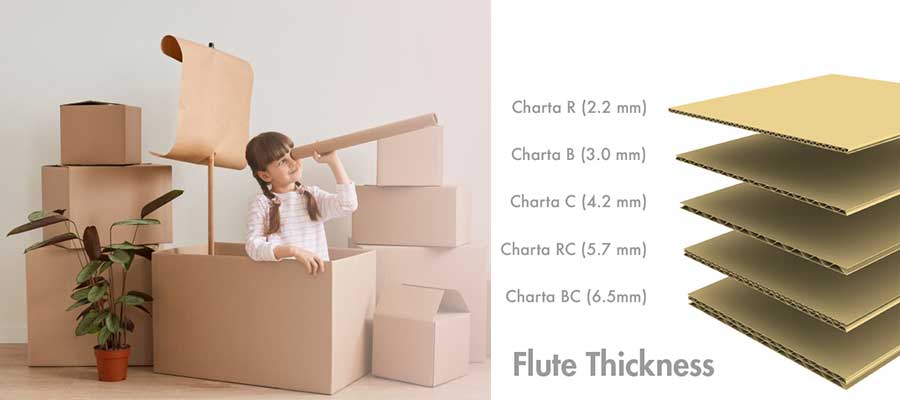
A corrugated box is a rigid shipping container made from corrugated fiberboard, featuring a wavy (fluted) middle layer sandwiched between two flat linerboards. This multi-layer structure provides superior strength, cushioning, and protection for products during storage and transportation while remaining lightweight and cost-effective.
A corrugated box is made from corrugated fiberboard, which consists of:
- Outer Liner (top flat layer)
- Corrugating Medium (wavy/fluted middle layer)
- Inner Liner (bottom flat layer)
These layers are glued together to form a corrugated board, which is then cut, scored, folded, and glued to create the final corrugated box or carton.
Why Corrugated Structure is Effective
The corrugated structure uses engineered geometry where arched flutes between flat liners create air columns that distribute weight evenly, absorb shocks, and provide exceptional compression strength relative to the material’s weight and cost.
Key Benefits:
- Lightweight yet strong
- Excellent cushioning and shock absorption
- Cost-effective and recyclable
- Customizable for various product sizes
Main Paper Types Used in Corrugated Boxes
Corrugated boxes utilize three specialized paper grades: linerboard (flat outer/inner surfaces), corrugating medium (fluted center), and sometimes chipboard (recycled liner alternative). Each paper type serves distinct structural and protective functions based on fiber composition, grammage, and manufacturing process.
1. Kraft Paper
The most common and strongest paper used in corrugated packaging.
2. Test Liner / Chipboard
Recycled paper alternative, more economical than virgin kraft.
3. Corrugating Medium (Fluting Paper)
Specialized paper designed to form the corrugated flute structure.
Let’s explore each in detail.
Kraft Paper – The Industry Standard
Kraft paper is a strong, coarse paper produced through the kraft pulping process, using chemical treatment of wood chips (primarily softwood) to preserve long cellulose fibers. The name “kraft” derives from German meaning “strength,” reflecting its superior tear resistance and durability compared to other paperboard types.
Kraft paper is the backbone of the corrugated box industry worldwide.
What Makes Kraft Paper Special?
- Made from wood pulp (primarily softwood like pine)
- Produced via the Kraft pulping process (chemical pulping)
- Natural brown color (can be bleached white)
- Exceptional strength and durability
When I visit factories in India and the US, I notice that over 90% of production lines run kraft liner — manufacturers often say “test liner boxes fail during export shipping, that’s why we stick with kraft for critical shipments.”
Types of Kraft Paper in Corrugated Boxes
A. Virgin Kraft Paper (Primary Fiber)
Virgin kraft paper is manufactured entirely from new wood pulp without recycled content, yielding maximum fiber length and structural integrity for demanding packaging applications.
Key Features:
- 100% fresh wood pulp
- Highest strength and performance
- Superior tear resistance and burst factor
- Excellent for high-load and export applications
Best For:
- Heavy-duty shipping boxes
- Export packaging (overseas shipping)
- Electronics, machinery, and high-value products
- Food-grade packaging (FDA/EU compliant grades)
Weight Range: 125–300 GSM (liners typically 125–200 GSM)
B. Recycled Kraft Paper (Secondary Fiber)
Recycled kraft paper incorporates post-consumer or pre-consumer waste paper fibers, offering environmental benefits and cost savings while maintaining adequate strength for general packaging needs.
Key Features:
- Made from post-consumer or pre-consumer waste paper
- Strength lower than virgin but adequate for most applications
- More economical and environmentally friendly
- May contain mix of recycled kraft + some virgin pulp
Best For:
- General shipping boxes
- E-commerce packaging
- Retail packaging
- FMCG (Fast-Moving Consumer Goods)
Weight Range: 110–200 GSM
C. White Top Kraft Liner (Bleached)
White top kraft liner is virgin kraft paper chemically bleached to achieve a bright white surface, enabling high-quality printing and premium brand presentation on corrugated packaging.
Key Features:
- Virgin kraft bleached to white
- Smooth printable surface
- High-quality graphics and branding
- Food-safe grades available
Best For:
- Printed retail-ready packaging
- Cosmetics, pharmaceuticals
- Premium consumer electronics
- Food and beverage cartons
Weight Range: 150–250 GSM
Test Liner and Recycled Chipboard
Test liner is an economical linerboard manufactured primarily from recycled waste paper and tested for minimum performance standards. It offers cost-effective packaging solutions while promoting circular economy principles through waste material utilization.
When cost is a priority or sustainability is key, test liner becomes the preferred choice.
What is Test Liner?
- Made primarily from recycled waste paper
- Usually brown or grey in color
- Lower cost than virgin kraft
- Adequate strength for many standard applications
I worked with a client who exclusively used test liner for cost savings — they had three containers damaged during shipment to UAE. After switching to virgin kraft outer liner with recycled inner liner, their damage complaints dropped to zero.
Performance Comparison
| Feature | Virgin Kraft | Test Liner |
|---|---|---|
| Strength | High | Moderate |
| Cost | Higher | Lower |
| Printability | Excellent | Fair to Good |
| Sustainability | Moderate | High (recycled) |
| Moisture Resistance | Better | Lower |
When Should You Use Test Liner?
- Domestic shipping (low to moderate handling)
- Light to medium-weight products
- Budget-conscious projects
- Environmentally focused brands
Weight Range: 100–200 GSM
Corrugating Medium (Fluting Paper)
Corrugating medium is specialized paperboard designed to be formed into wave-shaped flutes, providing the structural backbone and cushioning layer between linerboards in corrugated fiberboard construction.
This is the wavy, cushioning layer sandwiched between liners.
Purpose of Fluting Medium
The fluting medium serves as the compression-resistant core of corrugated board, creating vertical columns that bear stacking loads and horizontal arches that absorb lateral impacts and vibrations.
Functions:
- Provides structural strength and rigidity
- Absorbs shocks and impacts during shipping
- Creates air space for insulation
- Determines stacking strength (vertical compression)
Types of Fluting Medium
A. Semi-Chemical Fluting
Semi-chemical fluting medium undergoes partial chemical pulping, retaining more lignin than fully processed kraft for enhanced stiffness.
- Partial chemical pulping process
- Higher strength than 100% recycled
- Common in North America and Europe
B. Recycled Fluting Medium
Recycled fluting medium is manufactured from recovered corrugated containers and mixed paper waste, offering the most economical corrugated board option.
- Made from waste paper (OCC – Old Corrugated Containers)
- Most economical option
- Widely used globally
C. Straw or Agro-Based Fluting
Agro-based fluting utilizes agricultural residue fibers like wheat straw or sugarcane bagasse as sustainable alternatives to wood-based corrugating medium.
- Made from agricultural waste (wheat straw, bagasse)
- Common in regions like India, China
- Eco-friendly alternative
Weight Range: 80–180 GSM (common: 100–140 GSM)
Key Property: CMT (Concora Medium Test)
CMT (Concora Medium Test) measures the flat crush resistance of corrugating medium, predicting the finished board’s ability to withstand vertical compression forces. This is critical for box stacking performance.
Key Paper Properties and Specifications
Paper specifications are standardized measurements defining performance including weight (GSM), strength (burst, crush), moisture content, and water resistance that determine corrugated board suitability for specific applications.
When selecting paper for corrugated boxes, these properties matter:
1. GSM (Grams per Square Meter)
GSM measures paper mass per unit area, directly indicating thickness and indirectly correlating with strength, stiffness, and cost.
- Indicates paper weight and thickness
- Higher GSM generally = stronger board (but depends on fiber quality)
2. Bursting Strength (Mullen Test)
Bursting strength quantifies the maximum pressure a corrugated board can withstand before rupturing when force is applied perpendicularly to its surface.
- Measures resistance to rupture under pressure
- Important for rough handling, heavy contents
- Expressed in kPa or PSI
3. Edge Crush Test (ECT)
ECT measures the cross-direction crushing force a corrugated board sample can endure, predicting how well stacked boxes will support top loads.
- Measures vertical stacking strength
- Critical for palletized or stacked storage
- Expressed in lbs/inch or kN/m
4. Ring Crush Test (RCT)
RCT evaluates individual paper’s ability to resist crushing forces perpendicular to its plane, contributing to overall board compression strength.
- Measures compression strength of paper
- Influences overall board ECT
5. Moisture Content
Moisture content represents the percentage of water weight in paper, critically affecting dimensional stability, strength, and processability during box manufacturing.
- Ideal range: 6–9%
- Too high → weak, saggy boxes
- Too low → brittle, prone to cracking
6. COBB Value
COBB value quantifies water absorption rate of paper surface over specified time, indicating moisture resistance for humid environments or liquid contact.
- Measures water absorption
- Lower COBB = better moisture resistance
- Important for cold chain, humid environments
Common Paper Combinations by Box Type
Different types of boxes use different paper combinations to keep costs controlled while maintaining the right strength level.
Corrugated boards are classified by wall type and paper grade combination.
1. Single Wall (3-Ply) Corrugated Board
Single wall board contains one fluted layer bonded between two flat linerboards, suitable for light to medium-weight products.
Structure:
- 1 Liner + 1 Flute + 1 Liner
Example Configuration:
- Outer Liner: 150 GSM Kraft
- Fluting Medium: 120 GSM Recycled
- Inner Liner: 125 GSM Test Liner
Applications:
- E-commerce shipping boxes
- General retail packaging
- Light to medium-weight products (up to 65 lbs/30 kg)
2. Double Wall (5-Ply) Corrugated Board
Double wall board features two fluted layers with three linerboards, providing enhanced stacking strength and protection for heavier products.
Structure:
- Liner + Flute + Liner + Flute + Liner
Example Configuration:
- Outer Liner: 175 GSM Virgin Kraft
- Flute 1: 127 GSM Semi-Chemical
- Middle Liner: 150 GSM Kraft
- Flute 2: 127 GSM Recycled
- Inner Liner: 125 GSM Test Liner
Applications:
- Heavy products (65–200 lbs / 30–90 kg)
- Fragile items (glassware, electronics)
- Export shipping
- Long-term storage with stacking
3. Triple Wall (7-Ply) Corrugated Board
Triple wall board incorporates three fluted layers and four linerboards, delivering maximum strength for industrial and export applications.
Structure:
- Liner + Flute + Liner + Flute + Liner + Flute + Liner
Example Configuration:
- All liners: 200+ GSM Virgin Kraft
- All flutes: 140+ GSM Semi-Chemical
Applications:
- Industrial machinery
- Very heavy products (200+ lbs / 90+ kg)
- Overseas shipping containers
- Replacing wooden crates
Virgin Kraft vs Recycled Paper Comparison
Virgin kraft uses 100% new wood fibers offering maximum strength, while recycled paper reprocesses waste material, balancing environmental sustainability with adequate performance for most packaging applications.
| Factor | Virgin Kraft Paper | Recycled Kraft / Test Liner |
|---|---|---|
| Fiber Source | Fresh wood pulp | Waste paper, OCC |
| Strength | Highest (long fibers) | Moderate (shorter fibers) |
| Burst Factor | 40–60+ | 20–35 |
| ECT | Higher | Lower |
| Printability | Excellent | Good |
| Cost | Higher ($$$) | Lower ($$) |
| Sustainability | Moderate (requires trees) | High (diverts waste) |
| Moisture Resistance | Better | Moderate |
| Color | Natural brown or white | Usually grey/brown |
| Best For | Export, heavy-duty, food | Domestic, standard shipping |
Industry Trend: Hybrid Approach
The hybrid approach strategically combines virgin and recycled papers within single board construction to balance cost, performance, and environmental impact.
Many manufacturers use:
- Virgin kraft outer liner (strength + branding)
- Recycled inner liner (cost savings)
- Recycled fluting medium (economical balance)
How to Choose the Right Paper
Choosing the right paper involves analyzing product weight, shipping conditions, stacking requirements, environmental factors, and budget constraints to specify optimal paper grades and board construction.
Step 1: Define Your Application
Identify specific product characteristics, distribution environment, and performance requirements.
Ask yourself:
- What is the product weight?
- What is the shipping method? (Air, sea, road, parcel)
- Will boxes be stacked? For how long?
- What are the environmental conditions? (Humidity, temperature)
- Is printing/branding important?
Step 2: Determine Required Strength
Match box compression strength and burst resistance to your specific needs.
Use these guidelines:
| Product Weight | Recommended Board |
|---|---|
| 0–10 lbs (0–5 kg) | Single wall, 32 ECT, recycled OK |
| 10–40 lbs (5–18 kg) | Single wall, 44–48 ECT, semi-kraft |
| 40–80 lbs (18–36 kg) | Double wall, 48–51 ECT, virgin liner |
| 80+ lbs (36+ kg) | Double/Triple wall, 61+ ECT, virgin kraft |
Step 3: Consider Cost vs Performance
Balance material expense against required protective capabilities to achieve minimum total cost of ownership including product damage.
- Budget-focused: Recycled liner + recycled fluting
- Balanced: Semi-kraft liner + recycled fluting
- Premium/Export: Virgin kraft liner + semi-chemical fluting
Step 4: Specify Paper GSM & Grade
Clearly communicate exact paper grades, weights, and performance requirements to suppliers for accurate quotation and manufacturing.
Example specification for a vendor:
“5-ply corrugated box:
- Outer liner: 150 GSM virgin kraft
- Flute 1: 127 GSM semi-chemical medium
- Middle liner: 140 GSM kraft
- Flute 2: 120 GSM recycled medium
- Inner liner: 125 GSM test liner
- Minimum 48 ECT, burst strength 275 PSI”
Global Standards and Certifications
Global standards are internationally recognized test methods and quality benchmarks ensuring consistent corrugated board performance measurement and comparison across manufacturers and regions.
Paper & Board Standards
- ISO 536 – Determination of grammage (GSM)
- ISO 2758 – Bursting strength
- ISO 3037 – Edge crush resistance (ECT)
- TAPPI T 810 – Bursting strength (North America)
- FEFCO – European standards for corrugated board
Sustainable Certifications
Sustainable certifications verify responsible sourcing, recycled content, and environmental management practices throughout paper manufacturing and corrugated box production supply chains.
- FSC (Forest Stewardship Council) – Responsible forestry
- SFI (Sustainable Forestry Initiative) – North American standard
- PEFC – Pan-European Forest Certification
- Recycled Content Certification – Verifies % recycled fiber
Frequently Asked Questions (FAQs)
What is the most common paper used in corrugated boxes?
Kraft paper (both virgin and recycled) is the most common, used in liners. Corrugating medium (usually recycled-based) forms the fluted layer. Approximately 80% of global corrugated production uses some combination of kraft liners with recycled or semi-chemical fluting medium.
Can corrugated boxes be made from 100% recycled paper?
Yes. Many corrugated boxes are made entirely from recycled paper (recycled kraft liners + recycled fluting medium). However, strength may be lower than virgin kraft, so proper GSM and design are essential. Boxes with 100% recycled content typically achieve 70-85% of virgin kraft strength.
What does GSM mean in corrugated boxes?
GSM stands for Grams per Square Meter, indicating the weight and thickness of the paper. Higher GSM typically means thicker, stronger paper. Common liner GSM ranges from 125-200, while fluting medium typically ranges 100-140 GSM.
Which is stronger: virgin kraft or recycled kraft?
Answer: Virgin kraft is stronger due to longer, intact fibers. Recycled kraft has shorter fibers (from repeated recycling) and lower strength, but it’s sufficient for many standard applications. Virgin kraft typically offers 25-40% higher burst and ECT values compared to equivalent GSM recycled grades.
What type of paper is used for printed corrugated boxes?
White top kraft liner or bleached kraft is used for high-quality printing. Some boxes use white-coated duplex or white test liner for cost-effective printing. The white surface provides superior ink adhesion, color vibrancy, and graphic resolution compared to brown kraft.
What is the difference between liner and fluting in corrugated boxes?
| Feature | Liner | Fluting (Medium) |
|---|---|---|
| Position | Outer & inner flat layers | Middle wavy layer |
| Function | Strength, printability, protection | Cushioning, stacking strength |
| Paper Type | Kraft, test liner | Corrugating medium |
| Weight | 125–200 GSM | 100–140 GSM |
Liners provide flat surfaces for printing and puncture resistance, while fluting creates structural columns for compression strength and shock absorption.
How do I know what paper grade my box uses?
Ask your supplier for:
- Paper type (kraft, test liner, etc.)
- GSM of each layer
- Burst strength or ECT rating
- Lab test certificate (if available)
Is kraft paper food safe?
Yes, virgin kraft paper can be food-safe if it meets FDA (USA), EU, or other regional food contact regulations. Recycled kraft is generally not food-safe unless specially certified. Food-grade kraft must pass migration testing and avoid contamination from inks, adhesives, or recycled content.
What is the environmental impact of virgin vs recycled paper?
Virgin kraft uses fresh trees so the carbon footprint is a bit higher, but if you use FSC-certified mills, there’s no major concern. Recycled paper saves landfill waste and uses 30-40% less energy, though de-inking requires chemicals. The best approach in practice is hybrid usage — virgin kraft on the outside (strong + good printing), recycled inside (cheaper + eco-friendly).
Can I request custom GSM or paper grade from manufacturers?
Yes. Most corrugated box manufacturers offer customization. Specify your requirements:
- Liner GSM
- Fluting GSM
- Paper grade (virgin/recycled)
- Strength targets (ECT, burst)
Custom specifications typically require minimum order quantities (MOQs) ranging from 500-5,000 boxes depending on manufacturer capabilities.